





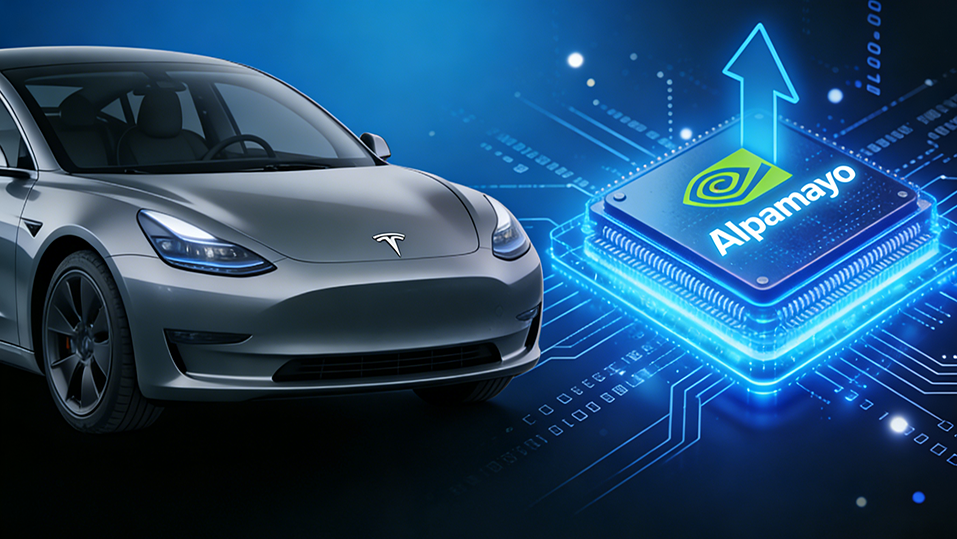
On January 9, a Morgan Stanley research report noted that Nvidia's recent aggressive push into physical AI deployment is raising new questions in the market about whether and how quickly traditional automakers can narrow the gap with Tesla in autonomous driving. In Nvidia's keynote speech at the Consumer Electronics Show (CES), self-driving cars and humanoid robots took center stage, with the new Alpamayo system emerging as one of the major highlights. Morgan Stanley pointed out that this technology stack aims to accelerate original equipment manufacturers (OEMs) toward scalable, reasoning-capable autonomous driving, with the potential to reshape the competitive landscape of driver assistance and autonomous driving systems.
However, Morgan Stanley reiterated that Tesla remains years ahead of its competitors in autonomous driving, highlighting its vertical integration capabilities, vast data advantage, economies of scale, and cost benefits. The report emphasized that Nvidia's technological advancements have not materially altered the firm's fundamental view of Tesla. The bank's baseline scenario assumes that over the next decade, the industry will widely adopt technology equivalent to or beyond Tesla's Level 2 FSD (Full Self-Driving). While Nvidia offers automakers a more capital-efficient entry point toward advanced autonomous driving, truly developing and integrating a complete autonomous driving technology stack remains a multi-year endeavor, not a matter of months.